Gadgets and Tech Reviews

Showing posts with label Laptops. Show all posts

Saturday, February 6, 2010

ASUS shows flexible-OLED concept devices

ASUS is showing off its new Waveface family of concept devices. Two of these use flexible OLEDs. The Ultra is a wearable (on the wrist) mobile phone that is controlled with hand gestures or by touching the display.

ASUS Waveface UltraASUS Waveface Ultra

The Waveface Light has physical keyboard that pops up when folded up into the laptop form factor.

ASUS Waveface Light

Samsung's Transparent OLED Laptop Coming Soon

Plastic Electronics reports that Samsung Electronics will release products using its clear active matrix OLED displays within the next 12 months. Samsung displayed prototypes using the clear AMOLEDs during CES 2010 back in January. However this is the first indication that the models on display will actually head to retail any time soon.

The laptop sporting Samsung's clear AMOLED allowed the user to see objects placed behind the screen while still offering sharp, bright images on the display. While the actual technology was quite impressive, the ability to see movement through the AMOLED screen looked to be somewhat distracting.

Plastic Electronics said that the first device to go commercial using the tech will be Samsung's IceTouch MP3 player (YP-H1). This device is a portable all-in-one that plays music, DVDs, tunes in FM radio stations, and more. The estimated price will be around $328 USD when it finally hits the market.

Reid Sullivan, VP of audio/video and digital imaging marketing at Samsung Electronics America, said that the AMOLED display should raise the bar for the next generation of portable devices. While that's all fine and dandy, where's that cool 14-inch laptop we saw at CES 2010? Apparently that should be on the market within the next twelve months too.

"We have a lab in Korea that is currently working on developing a laptop with partially-transparent screen," Sullivan said. "Soon, I imagine that all Samsung's audio-visual products will feature this technology. We want to be the first in this market."

Tuesday, November 11, 2008

New Macbooks-Jailbreaking Don’t Mix

Those who are still into jailbreaking iPhones/iPod Touches and are tempted to buy the new Macbooks might want to reconsider buying this latest line of laptops from Apple.

New Macbooks refusing to recognize Jailbroken iPhones/iPod Touches

Some users have reported that they’re experiencing connectivity issues when trying to jailbreak their iPhones/iPod Touch using these new Macbook laptops. It’s still not certain as to what’s really prohibiting these Macs from continuing the normal jailbroken process, but iTunes is certainly being considered as an early suspect. Here’s what Gizmodo has to say about the whole situation:


“It’s a very specific problem, too — the tool still runs, and users who have a pre-modified firmware created on another Mac or Windows machine are able to ‘restore’ their devices to a jailbroken state without any trouble. It’s the creation of modified firmware, which is the central purpose of the Pwnage tool, which has been axed.”

For now, I think it’s best to stay clear of these new Macbooks if you’re still interested in the whole jailbreaking process unless you’ve got a spare PC lying around the house you can use to indulge your little hobby. Anyway, you can allows opt to give up jailbreaking for a brand new laptop.

So, which will it be; jailbreaking or a new Macbook? Either way, you’ll end up with an expensive Apple device that probably should be worth a lot less than what it’s retailing for at the moment, but is definitely way cooler than its cheaper rivals that are out in the market today.

Wednesday, November 5, 2008

Dell Inspiron Mini 12: Bigger display, Thinner body

While Asus may have had the early advantage in the ultra-portable laptop race, the rest of the pack is catching up as their second generation devices are slowly trickling in. To be more specific, Dell has unveiled their next netbook offering, the Inspiron Mini 12.

Dell Inspiron Mini 12: Bigger and thinner

This new version comes with a large 12-inch display, a first in the netbook industry. Two variants will be offered under this new line: a 1.3GHz Atom Z520 model and a 1.6GHz Atom Z530 version. Windows XP and Ubuntu will still be the OS options for 2008 but come 2009, Windows Vista will likewise be available as well. There will also be 60GB or 80GB HDD options and a 6-cell battery upgrade that’s definitely a welcome treat. The Mini 12 might be larger due to the bigger screen, but it’s also slimmer measuring in a mere 21mm thin.

It’s scheduled to roll out internationally in November, but it will still depend on the local distributors on when it will exactly become available in their respective markets. The US starting price is $600 or close to P29K when converted using a $1=P48 exchange rate. It’s not exactly cheap, but with a thinner profile and a size that’s close to regular laptop, this might be the best netbook to date as far as form factor design is concerned.

With the Inspiron Mini 9 yet to become available in the market, it makes you wonder; will Dell Philippines completely skip out on the Mini 9 in lieu of the Mini 12 or will they just push back the debut of the Mini 12? I’m hoping that it’s the former since this looks like a better deal than what the Inspiron Mini 9 has to offer.

Tuesday, November 4, 2008

MSI Wind U120 coming in November to Asia

While the MSI Wind may already be considered a success in the local market, it is apparent that MSI is not content with just one netbook under their name as they’ve announced the Wind 2 set for a November debut in Asia.

MSI Wind2 coming in November

You can expect a new body design, SSD storage options, 3.5G modem, and of course, an Intel Atom processor. While the price is not yet definite and no exact figure has officially been given, rumor has it that it might cost roughly $600 or P28K. It’s really not that affordable, but hey, considering the Wind ranks as one of the top netbooks in the market today in sales as well as in performance, this second iteration might just be worth it.

If you’re on the hunt for a netbook that’s worth investing in, I would suggest you wait for the Wind 2 (U120) to arrive first before making any purchases at the moment. Besides, if you don’t like it, its presence in the local market will drive current prices down which will result in giving you a better deal in the end. Let’s just hope they stay true to the November release date so we won’t have to wait long for its availability. As for current MSI Wind owners, you can download the latest BIOS to get some added speed for your soon to be outdated netbook.

Sunday, October 5, 2008

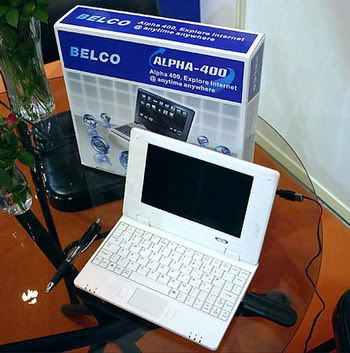
Belco Alpha-400 Laptop: Simpler than others at .70 kgs.

Alright, here’s the deal.

I want a laptop that’s small in size. And I mean very small... like half of a Letter-size paper. And it will allow me to surf the Internet and check my mail.

Forget the webcam, I’m shy when it comes to showing my face online but I do love to chat so include that. Make sure that it has Wi-Fi ‘coz I love free Internet access while I take my morning coffee at Starbucks and others... I hate bringing with me a huge power adapter. I don’t want to carry around that gold-bar-like adapter. Make it small... like those ones for mobile phones? Oh, and don’t forget the USB ports."

Do you think we just made up a script? Maybe. But consider all the specs mentioned above, make it tangible, and it works. Would you be impressed if there was a laptop measuring half the size of a bond paper?

That’s the Alpha-400 pictured above. Like most netbooks, it is small and easy to carry. If that doesn’t impress you, then maybe the supplied power adapter would. Because unlike conventional power adapters for laptops and netbooks, this one has a mobile-phone-charger-like power adapter.

If you are familiar with earlier types of Nokia phone chargers, the Alpha-400’s power adapter looks very much like it, but a little bigger in size. The whole package contains only three items, the netbook, the power adapter, and a miniCD (which you may not use afterall). Heck, even the battery is built in.

The size of the Alpha-400 is a bit thicker than the EeePC. It has a 7-inch "Digital A Grade" LCD display, three USB ports, an SD card slot, and built-in speakers, Wi-Fi, and Ethernet port. This specifications is just what a person needs for Internet surfing, photo sharing, and for personal entertainment.

Perhaps one notable drawback of the Alpha-400 is the built-in 2-Gigabyte NAND Flash drive. That’s what the SD card slot and USB ports are for. To expand disk space, just plug in an SD card (of up to 32GB) or an external hard drive (of whatever size as long as it doesn’t exceed 160GB).

"So you get a portable adapter and an ultra-portable PC. But what can it do?" you may ask.

Well, the simplest answer to that is what the EeePC primarily offered - Surf, work, & play. Running on Linux, the user interface looks similar to that of the Linux-based EeePC. You will see five tabs - Internet, Work , Play, Settings and Others - in that order.

On the first tab, this is where you connect to the Internet using Firefox as your default (and only) web browser. Click the Wi-Fi icon to connect to access points, and Xip chatting if you want to chat.

Although you have to set your account first before you start chatting and it’s not that hard to do. All it will ask is where you want to chat (like Yahoo! Messenger, Google Talk, AIM, etc) provide your account name and password, and your done.

The email box is actually your POP3 mail, which you can setup so that you don’t have to open your browser, go the your email site, and log in. There’s an included FBReader if you any ebooks that you want to read on the Alpha-400.

The Work tab has basically an Office applications suite, so if you looking for apps for Word, spreadsheets, and PDF viewer, it’s here. There’s a pre-installed dictionary, calendar, and calculator also. On the Play tab, is where the pre-installed multimedia apps are. Yes, there’s no games but the media player, Xip Flash player, and Paint Brush apps. You may find the default theme boring so just change it by going to the Settings tab. Other things you can change here are the sound settings, date and time, and netbook’s profile (or your profile as the owner).

If you happen to connect the Alpha-400 to your office network, check the network settings here, too.

The last tab contains the Xip Tar (much like WinZip) and the voice recorder apps. You need a mic though to use this application. Perhaps that, and a nice carrying case is all the Alpha-400 need and you are ready to go.

Wednesday, September 17, 2008

HP intros HDX16 / HDX18 entertainment notebooks

Whoa, boy -- HP just went loony on us tonight, and in the midst of everything else, we found a new pair of HDX notebooks. Kicking things off is the X16, which boasts a woefully under-pixelated 16-inch 1,366 x 768 resolution display, a 2.26GHz Core 2 Duo P8400 CPU, NVIDIA's 512MB GeForce 9600 GT, 4GB of DDR2 RAM, a 320GB 5,400RPM hard drive, dual-layer SuperMulti optical drive and built-in WiFi / Bluetooth. As for the beastly X18, you'll find a lot of the same kit internally, but the 18-inch 1,920 x 1,080 display is one we can really salivate over; additionally, this one ups the ante with twin 250GB HDDs and a Blu-ray reader. Each unit includes the essentials: an Ethernet port, multicard reader, integrated Altec Lansing speakers, ExpressCard slot, four USB 2.0 sockets, audio in / out, HDMI / VGA and a 4-pin FireWire connector. Both units should ship later this month starting at $1,249 and $1549, respectively.

Thursday, September 11, 2008

HP 2133 Mini-Note

HP's 8.9-inch 2133 Mini-Note is apparently a raging success, so it makes sense that the company would want to expand the line, and it looks like we might be getting a preview of what's in store with the Digital Clutch, a bright red 10-inch netbook that debuted last night during designer Vivienne Tam's fashion week show in NYC. Not much is known about the internals, but the case sports an Asian-inspired peony flower design, and the screen fills the entire lid with very little bezel. If we had to guess, we'd say that it's more likely that there's a VIA Isaiah chip in there instead of an Atom, given the C7M found in the current Mini-Note, but we'll see -- and hopefully soon, since at least one HP rep apparently confirmed that the machine is the next generation Mini-Note.

Friday, August 22, 2008

The XFX GeForce 9500 GT: The multi-media multi-tasker

While the movie industry continues to churn out sequels and other unoriginal hype, XFX offers up something new and exciting—the XFX GeForce 9500 GT, the ultimate multi-media multi-tasker that’s known for all it can take.

Take One: Like taking and sharing photos? The 9500 GT delivers an improved 3D experience with Microsoft Windows Media Center that allows users to offload tasks from the CPU, which increases productivity and enables users to share, edit and manage photos and videos better than ever before.

Take Two: The 9500 GT takes video playback to a new level, with advanced PureVideo HD technology that delivers jaw-dropping Blu-ray movie picture quality with reduced CPU utilization and low power consumption.

Take Three: Live to take out opponents? Offering a 3X performance increase over comparable 8 Series GPU and PCI Express 2.0 compatible cards, the 9500 GT delivers the most gaming horsepower available at this price point, and, since these cards are compatible with PCI Express and the new PCI Express 2.0 bus architecture, the 9500 GT ensures that users will be able to play all of today’s—and tomorrow’s—games the way they were meant to be played.

Take Four: All of these breath-taking features can be doubled. The XFX GeForce 9500 GT is SLI ready, which means that users can purchase two cards to deliver twice the performance of a single-card set-up.

Which is why we recommend that you take five and head for your nearest e-tailer or shop.

To learn more about the XFX GeForce 9500 GT, please visit www.xfxforce.com.

Is this the Apple MacBook Killer?

Yeah, I know, somebody more famous said this line decades ago. That "somebody" knocked out several world-class challengers to the throne of "the greatest" during those days.

But that "somebody" did not know the Lenovo ThinkPad X300 back then, the latter now among those vying for the best, super-skinny laptop -- pound for pound.

In the other corner, of course, is "someone" I’ve yet to meet and play with.

The Lenovo ThinkPad X300 I’ve met, and glad to have made its acquaintance.

From what I’ve heard, "somebody" beat Lenovo to the punch when it released, with so much hype, allegedly the world’s thinnest laptop.

Lenovo, I heard from the grapevines, rushed to take the challenge and, a few months or so, birthed a super-sleek three-pound baby in the ThinkPad X300 -- make that exactly 3.12 pound, battery included, and a just a shade below an inch think..

First impression: I liked the conservative black slab design that housed a full 13-inch scoreen and full keyboard.

The ThinkPad X300, I'm glad to find out in a short while, is not crampy with its built-in DVD drive, three USB ports, a wired ethernet jack while boasting of a rugged solid-state drive.

The internal chassis and roll cage, according to specs included in the box, uses an advanced carbon-fiber/glass-fiber material for both strength and weight. The case material is made of magnesium, designed for accidental abuse and drops, and for more peace of mind, a double latch mechanism with button release to hold the screen closed.

The speakers are located on the corners of the notebook, the heat vent grills, painted black, goes well with the overall looks.

The ThinkPad X300 sports an Intel 1.20GHz Core 2 Duo L7100 processor that’s more than enough to run office applications and any general web related tasks.

The 13.3" WXGA+ screen is eye-friendly with its 300 nit LED backlit spec. The full-sized keyboard has zero flex, a matte finish to the keys for durability, with a well-sized touchpad with scrolling areas. The screen feels larger and that 1,440 x 900 resolution is a big plus.

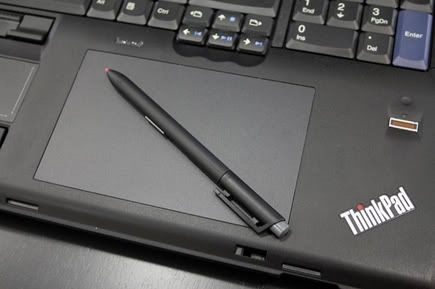
The palm rest area has a rubberized paint finish, very smooth, close to the fingerprint reader.

I gave the X300 quite a go the short I had it, and found out it has good sound and speakers. Sound-distortion is alien here. All you get is the good grooves, baby.

Watched a couple of movies, played a game or two, and I loved it. Hey, what can I say, I'm that easy to please.

Of course I felt bad when the time came to return the X300 to its rightful owner. I'm just glad that I met, and had a grand time.

What’s this? I heard "somebody" wants to really challenge the Lenovo ThinkPad X300. Oh yeah, well bring it on!

Wednesday, August 20, 2008

Lenovo W700: Graphic Artist’s Dream Machine


Laptops have surely come a long way. There are lappies available that are ideal for gamers, for budget conscious individuals, for corporate people, and now, even for graphics artists and designers.

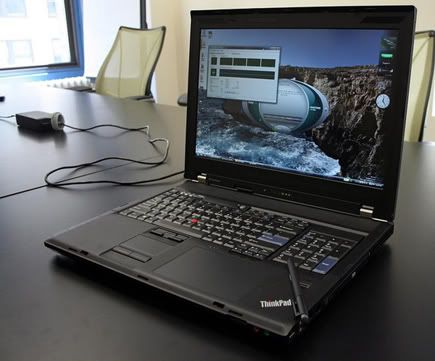
The Lenovo ThinkPad W700 is more than your average 17-inch notebook. Aside from the professional grade WUXGA display with 400 nit brightness and auto-color calibration sensor, it’s the first laptop to integrate a Wacom digitizer into its design the perfect mobile computer for photographers, graphic artists, and others in a similar field. Rounding up its specs is an Intel 3.0GHz Core 2 Extreme Quad Core processor, up to 8GB DDR3 RAM, 1GB Nvidia Quadro FX 370M vidcard, dual HDD bays configurable in RAID 0 or RAID 1, 7-in-1 card reader, 5 USB ports, and thanks to its size, a full numeric keypad. If you need to hook this bad boy to an external display, you can do so through the dual-link DVI, VGA and display port.

It’s slated to be released in September with a starting price of a whopping $2,978 for the most basic model. It’s expensive, but then again, this isn’t your regular run-of-the-mill laptop either.

Sunday, August 10, 2008

Next for Apple: New iPods, Laptops?

Piper Jaffray analyst Gene Munster thinks Apple will introduce new iPods and new model laptop at a special event in September.

It's not entirely speculation - the analyst observes Apple to have held such an event for the last three years. And while the analyst doesn't expect an iPhone nano or MacBook touch to appear at the show, he does anticipate some major revisions of Apple laptops.

Munster predicts redesigned MacBooks at lower prices, along with a redesigned MacBook Pro.

"We note that the MacBook has had the same design since its launch over two years ago, and the MacBook Pro has had essentially the same design since its launch over 2.5 years ago, which was very similar in design to the PowerBook G4 released over 5.5 years ago," he told clients.

The analyst also expects Apple to introduce higher-capacity iPod shuffles and nanos at the same prices as they currently are - but does not predict significant redesigns in the product. The iPod touch may be redesigned and its price lowered, Munster warned.

The analyst termed a touchscreen Mac as unlikely, but thinks it is in development for launch in 2010. He also believes a smaller version of the Macbook Air is likely in 2009.

Why Microsoft and Intel tried to kill the XO $100 laptop

At the World Economic Forum in Davos in January 2005, Nicholas Negroponte, supreme prophet of digital connectivity, revealed a strange tent-like object. It was designed to change the world and to cost $100. It was a solar-powered laptop. Millions would be distributed to children in the developing world, bringing them connection, education, enlightenment and freedom of information. The great, the good, the rich and the technocrats nodded in solemn approval.

And then some of them tried to kill it.

Microsoft, makers of most of the computer software in the world, tried to kill it with words, and Intel, maker of most computer chips, tried to kill it with dirty tricks. Of course, they don’t admit to being attempted murderers. And when I introduce you to Intel’s lovely spokesperson, Agnes Kwan, you’ll realise how far their denials go. But the truth is the two mightiest high-tech companies in the world looked on Negroponte’s philanthropic scheme and decided it had to die.

Intel's computer, which could cost as little as £250, will join a string of cheap laptops on sale in the US and Europe

Yet, 3½ years later, the laptop is clinging on to life. It costs around $190 rather than $100 and it is called the XO. It is no longer like a tent, but it can still be solar-powered. It is a technological triumph. But only 370,000 are in use and another 250,000 ordered. One Laptop Per Child (OLPC), the company formed to run the project, is still driven by the same old idealism, geekery and technical brilliance. But Negroponte and his young staff are older and wiser. They were stunned by the savagery of the competition they faced – competition plainly intended to destroy a philanthropic idea. “I had wildly underestimated,” says Negroponte, “the degree to which commercial entities will go to disrupt a humanitarian project.”

For three reasons the XO turned out to be a gross provocation to the big players in the computer industry. First, it was always going to be cheap, undercutting the competition by thousands. Computers only cost as much as they do because the makers of the software – primarily Microsoft – go to enormous lengths to make their products necessary and expensive, and because makers of the hardware are constantly adding new features that you probably don’t need.

In fact, electronics have plummeted in price and there’s no real reason why you can’t get a decent laptop for a maximum of $400.

Second, the XO uses an AMD chip. The monopoly chip-maker in the world is Intel. It has three-quarters of the market, with AMD second. AMD and Intel hate each other with a hatred as hard as that of Hamas and the Israelis. For Intel, the idea of hundreds of millions of AMD laptops out there was intolerable. Intel could lose their market leadership – but not if Agnes has anything to do with it.

Third, it does not use software by Apple or Microsoft. Instead, it is run by Sugar, a free operating system devised by geeks for the love of it. For Microsoft in particular this was also intolerable. Its Windows operating system is the industry standard. Apple’s system is much better, but Windows, through sheer Microsoft muscle, has been made to appear necessary. The new massive non-Windows user base threatened by the XO is the sort of thing that seriously cuts into Bill Gates’s me time.

“This was a project that could operate outside the regular business world,” says Ethan Beard, a former OLPC board member representing Google, one of its backers, “and that’s not an unreasonable expectation. But it is in some ways threatening to businesses and when you threaten businesses, especially very large ones, they are going to react in ways that hurt you.”

So the big boys stamped on the fingers of the XO. Intel called it a gadget and then made their own cheap laptop, the Classmate, which they sold aggressively against the XO. Microsoft’s Gates said, “Jeez, get a decent computer…” and then went around trashing Negroponte’s earnestly well-meaning machine.

“He said that sort of thing privately to people I knew,” says Negroponte. “There was a fair amount of that. I was annoyed enough to say so, and he apologised for it – a lot of good that did.”

Gates’s reaction was especially tasteless. Apart from being – like, apparently, everybody else rich, powerful or famous – an old friend of Negroponte, he is the greatest philanthropist in the world. But even though he’s stepped down as the head of Microsoft, he remains almost paranoiacally defensive of Windows.

Yet, miraculously, in spite of all this the XO is still alive, clinging to the cliff face. But for how much longer?

The Massachusetts Institute of Technology (MIT) is geek central, the greatest school of its type in the world. Along with Harvard, it dominates the city of Cambridge, across the river from Boston. MIT is a city within a city consisting of the campus but also the penumbra of gigantic, architecturally eccentric buildings in which live the high-tech companies that graze on the institute’s talent. Around Kendall Square, people shuffle along the streets lost in thought. In the cafes they read and write notes on yellow legal pads. This is where money meets IQ. It is not quite like anywhere else on Earth.

It was here that, in 1985, Negroponte founded MIT’s Media Lab with the idea of “inventing a better future”. It was an idealistic attempt to show that the computer and communications revolutions could, indeed, make the world a better place. The XO – high tech for the poor and unconnected – was the perfect embodiment of the Media Lab’s idealism.

In the OLPC boardroom in an office in Cambridge I meet Negroponte. He is a staggeringly well-connected Greek-American from a wealthy background. The background and the connections give him a slightly remote, slightly languid, though not pompous or grand, air. His staff at OLPC regard him affectionately and with some bemusement.

A techno-utopian by nature, MIT is his natural home. And it was at MIT in 1968 that he met Seymour Papert. Papert had worked with the great educational theorist Jean Piaget. From Piaget’s work, Papert had developed the learning theory of constructionism. Put simply, this means that children learn most effectively when they are doing things rather than just sitting and listening. Negroponte became an enthusiastic constructionist. It synched with his world-transforming view of technology. Computers were to be the perfect constructionist tool, allowing children to discover and make things on their own. If Negroponte is the father of the XO, Papert is its grandfather.

“The question we were asking,” says Walter Bender, long-term Negroponte collaborator, “was not the ‘how’ of computing but the ‘why’. And the primary answer was learning.”

Constructionists tend to be sensitive creatures, primarily because they have been so angrily attacked. Children have to be told something, say the critics: they can’t just be set free to do anything they feel like. Sane constructionists accept this, but, to be honest, I do have a suspicion that they may be more geeks than educators. They want computers to work in schools because they like machines.

Through various experiments, Negroponte and his colleagues zeroed in on the idea of the computer as the key that would unlock the predicament of the world’s poor. In 1999 Negroponte built a school in Cambodia.

Then, in 2001, he suggested his son go to it and, using a satellite link and a few laptops, connect it to the internet.

“This was a very remote village – no electricity, no telephone, no TV – but the wi-fi was so well done that when I asked myself if you look at the constituent parts they were all replicable and in most cases the prices would scale down. The one exception was the laptop. That became the focus…”

Yet laptops were expensive and they never seemed to get any cheaper, they just got more complicated. They have become loaded with “bloatware” – over-featured, over-complex software. “Everything becomes like an SUV,” says Negroponte. “It’s crippling because, like an SUV, most of the power in that machine is being used to drive the machine, not you or I.”

Pricey laptops meant that the Cambodian scheme was not “scaleable”. Cheap wi-fi connections could be scaled up, but then each child would need a laptop and there was no cheap way of providing these. This was a huge frustration to Negroponte, who firmly believes in constructionist learning through computers and that a connected world would be a better, more harmonious world.

But, I point out, it doesn’t seem to have worked so far. Our new connectivity hasn’t made us significantly less evil. “It’s not working as well as it should because not enough people are connected at the moment,” he admits.

So the price of laptops was standing between this world and a better one. By 2004, Negroponte was ready to do something about it. He asked Intel to provide a low-cost, low-power chip. “As long as you don’t call it a laptop,” said Intel, with the tactlessness that seems to be a corporate policy. It meant they didn’t like the sound of this new machine. “Did they actually say this?” I ask earnest Agnes. No comment.

But, for months, Intel did no more than think about it. AMD, in contrast, said yes in a few hours. So, by the time of Davos, Negroponte was ready to announce the new machine with an AMD chip. “Why didn’t you give us a chance?” whined Intel a month later. Remembering this, Negroponte laughs wryly: “It was like you get married and then your girlfriend comes back.”

For whatever reasons, Intel didn’t get it and AMD did. “I’m not sure,” says Dan Shine, a director of AMD, choosing his words with the care of a Hamas spokesman at the UN, “[that] Intel viewed it quite as holistically as we did.”

Negroponte had also hooked a spectacular range of backers: Red Hat, Google, AMD, Brightstar and News Corporation (the parent company of The Sunday Times). These each contributed $2m upfront and then a further $500,000. All the companies put in money as sponsorship rather than investment. This was, to the core, a pro-bono, philanthropic enterprise. OLPC, at Negroponte’s insistence, had been set up as a non-profit operation.

“It was probably the best decision we ever made,” he says, “but we came this close to not doing it. I was advised by absolutely everybody to make it a profit-making entity so we could make lots of money and then give it away… But the non-profit decision was important because it provided clarity of purpose – first, a head of state will talk to you because it’s about children and learning and not profit and, secondly, the best people will work for you for zero salary.”

Negroponte then went out to sell the machine. Connected as he is, he decided to use a top-down approach. He sold straight to governments and heads of state. It seemed to work like a charm. As if by magic, he conjured up promises to buy millions of laptops from Argentina, Brazil, Nigeria, Thailand, Pakistan and Libya. It was, in publicity terms, a brilliant coup. From nowhere this not-yet-existing machine seemed to be conquering the world. The press lapped it up. Negroponte was on a roll.

Unfortunately, none of the orders materialised. “He would go from prime-minister meeting to president-of-country meeting and that was his sales model,” says Rebecca Gonzales of AMD, who now advises OLPC. “And it didn’t work, absolutely not. As we have learnt in the business world, just because you have a handshake from the president or the prime minister, it doesn’t mean you have an order.”

In fairness to Negroponte, his strategy had at least earned OLPC a high-publicity profile, and some of the non-orders were due to unforeseeable events – there was, for example, a military coup in Thailand.

“There’s nothing I regret about this strategy,” he says. “It created enough hype and pictures of Nicholas shaking hands with heads of state that, back in Taiwan where 250 engineers were working on it, people felt part of something.”

Meanwhile, industry-changing technologies were being applied to the design of the computer itself. In its finished form there are three things this computer has that all laptops should have but don’t.

The first is its screen. This was created by OLPC’s chief technology officer, Mary Lou Jepsen. It is, first of all, cheap. Jepsen points out to me that the screen is the most expensive item in any laptop and yet, for some reason, it is not normally included in the hardware costs, so it gets overlooked. Secondly, it is superbly readable in any light. It isn’t glossy or reflective. It is probably the best laptop screen in the world.

The second thing is mesh networking. This means if you have 10 XOs in a room, they can all talk to each other directly without going through the internet. So even in an African village without wi-fi, the people could have their own intranet. Mesh also means that when they do have a wi-fi connection, its range can be massively extended as the mesh picks up the signal and rebroadcasts it. The XO has probably the best connectivity of any laptop in the world.

And third, it probably has the lowest power consumption of any laptop, essential in environments where power is at a premium.

The hardware, in short, is superb. The software, however, has problems. Sugar is a development of Linux, a free, “open source” – more of that in a moment – operating system.

It is tuned specifically to the needs of children and they, I am told, pick it up quickly. Adults who have any experience of computers, however, will find it hard. It has also been quite buggy. And the user interface (UI) – the way you interact with the machine – is very hard work compared with Windows and Apple. “It can take years to get a UI right, so starting from scratch for me was a question,” says Ethan Beard.

All of which was bad news for the computer when it first appeared – it went into production in November 2007. A review in The Economist in January said “the implementation of the technologies is terrible” and described the Sugar operating systems as “cumbersome”. The Economist being read by precisely the sort of people who might buy this machine in quantity, this was catastrophic. It was also not, given the quality of the hardware, entirely fair.

And the truth of the design is that it had to be done that way to get the price down. Both hardware and software had to be rethought from the ground up. This is most difficult with the software in the time available, because good user interfaces takes many years to develop. Apple – the industry leader in this area – is only as good as it is because of three decades of development. But Sugar was free, and buying Windows off the shelf – Apple does not license its system – would have almost doubled the price of the machine.

There is a further element to all this which is crucial to understanding the idealistic, visionary zeal of the geeks who worked on the machine. From its beginnings in the 1970s, the personal computing revolution has been suffused with countercultural idealism. Apple was born of the conviction that the “people” should have computing power and IBM, the then big player, was the corporate beast that was not going to provide it. Even now it, too, is a corporate beast, Apple still markets itself as the countercultural alternative to a Microsoft-powered machine. But the ultimate countercultural gesture is “Open Source” software.

With Apple remaining a minority brand, Open Source is the biggest threat to the dominance of Microsoft. Buy Windows Vista Ultimate – the latest Microsoft operating system – at PC World and you will pay £230. Vista is not popular, but hundreds of millions have to have it. Linux, the Open Source operating system, is, if you are geek enough, free. No wonder Microsoft said from the beginning that they couldn’t back an Open Source machine like the XO – they would be promoting their biggest weakness.

Linux is not just software, it is a countercultural movement whose most fervent adherents believe in the overthrow of the Microsoft monopoly. Sugar is based on Linux and Sugar’s greatest lover is Walter Bender.

I meet Bender in the Media Lab. There is something shy about him. A senior figure at the Media Lab, he left OLPC. He was its most high-profile departure. The reasons are disputed. Some say he was just too awkward to work with. But his reason is clear. OLPC had decided to produce a new “dual boot” version of the machine – this means it can either run Sugar or Windows. For Bender, this was a betrayal of the Open Source faith.

Open Source allows users to change any or all of the software, to “drill down” into the very depths of the machine. For Bender, this makes it more true to the constructionist faith than any proprietorial software. Children can remake the XO from the bottom up, impossible with a Windows machine. “I left because the future of Sugar was going to be bigger and bolder than just being confined to the OLPC laptop,” says Bender.

The question raised by Bender’s departure was: is OLPC an open-source crusade, or is it a project to spread computing to the poor by any means available? In practice, OLPC has answered no to the first and yes to the second. But, if it is just about spreading computing to the poor, then is the XO itself that important? Wouldn’t any cheap laptop be just as good? It is this question that lies at the heart of the most spectacular crisis surrounding the project: the war with Intel. And here we come to my new best friend Agnes.

Microsoft may have used words and a refusal to co-operate as its weapons against the XO; Intel used brute force. The company dominates global computer hardware in the way that Microsoft dominates the software. And, like Microsoft, it is a fierce protector of its ascendancy. So fierce, in fact, that the Federal Trade Commission in the US has recently opened an investigation into its alleged anti-competitive practices designed to shut out AMD. On the academic side of the OLPC project, they were shocked by the ferocity with which Intel attempted to kill their product. On the business side, they just shrugged and they all said the same thing: “It’s in their DNA.”

Intel’s response to the XO was the Classmate. It is nothing like as radical a machine in that it is, basically, a straightforward Windows laptop. Intel will tie itself in knots rather than admit its laptop was a response to OLPC’s.

My Intel spokesperson, Agnes Kwan, seems to exist to evade the issue. I played e-mail ping-pong with her over several days. She was trying to avoid giving me any dates that would show the Classmate came after the XO. This included sending me a bizarre and barely literate “ethnographic” study of computing in the developed world. In the end, all she would say about the timeline of the Classmate was: “It’s hard to pinpoint a start date with the nature of ethnographic research in which ethnographers collect data over a long period of time.” Sorry?

Many in the industry says the Classmate was intended to be an XO killer and that’s how Intel behaved. Their formidable global sales operation charged into any market in which OLPC might get a foothold, trashing the XO and pushing the Classmate. Nigeria, where Negroponte had one of his handshake deals with President Obasanjo, was a typical example. In August 2006, Craig Barrett, Intel chairman, wrote a hard-sell letter to Obasanjo asking for a meeting in which he could explain their World Ahead programme, “which is chartered to extend PC access to the world’s next billion users”. This programme had been launched in May 2006, 15 months after the OLPC announcement at Davos – bit of a dead giveaway there, Craig. Barrett’s letter was backed up by documents listing “the shortcoming of the OLPC approach”.

These documents having been leaked, they became a significant embarrassment to Intel. Here was a mighty company trying to crush a philanthropic project. In May last year they seemed ready for a truce and a deal was done. Intel would join the OLPC board, invest $6m in the company, there would be moves to put an Intel chip in the XO, and there would be no more slagging off of the XO in the marketplace. The deal failed with almost Middle Eastern speed and finality. Intel attended only one board meeting and Intel salesmen – “it’s in their DNA” – carried on slagging off the XO. Intel also tried to parcel up the world into easy markets for Intel and hard ones for OLPC.

“You mean,” says Negroponte of this phase, “Ethiopia is mine and Mongolia isn’t?”

At the same time, Negroponte was demanding Intel stop marketing the Classmate. Intel refused on the basis that there was room for a plurality of solutions to the “digital divide”. On this issue – says Agnes – the deal collapsed and Intel left the board in January. Even the departure was contentious. Negroponte said there was a deal to say nothing until there could be a joint announcement. But, of course, Intel went ahead and spoke to the press anyway.

“It’s quite obvious,” says an OLPC spokesman, “that they waited until very late in the day to make it nearly impossible for OLPC representatives on the East Coast to get their side of the story in the ‘first stories’.” Bruce Sewell of Intel e-mailed Negroponte to apologise, saying “instructions were misunderstood internally”.

I put all this to dear Agnes. No comment.

Destructive as all this sounds, it represents a kind of success for OLPC. First, whatever Intel tries not to say, it is almost certain that the OLPC inspired the Classmate and cheap computers from others. Furthermore, as many on the business side of OLPC pointed out, the very fact that giants like Microsoft and Intel were bothering to trash the XO indicated the power of this idea to get under their skin. “If Nicholas hadn’t said what he said in January ’05,” says Dan Shine at AMD in Austin, Texas, “this machine wouldn’t be here and a lot of other technologies and discussions wouldn’t be here. He accelerated people getting access by probably years.”

And, finally, however “impure” it may be to the open sourcers, putting Windows on the XO was a huge breakthrough in the computing industry because Microsoft has let them have Windows XP for $3 per computer. One of the previous industry certainties was that Microsoft never ever sells anything cheap.

So, whatever happens to the XO, OLPC has changed the industry. The question then becomes – what will happen to the XO? A new OLPC machine, which is configured more like an electronic book, is due out in 2010 and, meanwhile, the XO is making inroads in Latin America and there should soon be one million in the hands of children in 16 countries. Sweet Agnes can only say that the Classmate has sold “tens of thousands”. If the war with Intel is to be won by sales, then OLPC is well ahead.

Palo Alto is the Californian equivalent of Cambridge’s Kendall Square. This time the great IQ warehouse is Stanford University. The streets of the town are, in a Californian way, less intense than those around MIT. But the corporations are here, not least Facebook, the vast social-networking site. In one of their many buildings, I meet Ethan Beard, an alarmingly young, alarmingly vigorous man. When at Google, he was sent to oversee their sponsorship on the OLPC board. Now, looking back, he thinks more radically than anybody else about the future of educational computing for the developing world.

“They could keep on coming up with innovations and license out the technology, take the money and fund OLPC. Or they could open-source the entire design of the computer.”

Or, he suggests, the whole system could be put into a “cloud”. Cloud computing means your machine does very little except contact the internet – everything else is taken from applications and storage in cyberspace. Beard thinks the whole OLPC project could live in the cloud, freeing it from the bonds of the heavy hardware earth through which it trudges.

But whatever future emerges from the heads of Nicholas, Dan, Mary Lou, Ethan, Rebecca, Walter or even Craig, Bill and the divine Agnes, the simple fact will remain that OLPC has been a noble attempt to do something the industry would never have done without provocation.

Computers are like drugs, literally. If the drug companies wanted to do the most good in the world, they would divert all investment from the illnesses of the rich – cardiovascular disease, cancer, diabetes – to the much more catastrophic ailments of the poor, primarily malaria, but also Aids. But they don’t; they sit comfortably on their high-margin drugs. Equally, if the technocrats really believed in the human value of universal connectivity – and all of them say they do – they would find ways of wiring southeast Asia and Africa. But they don’t; they sit comfortably on their high-margin laptops.

Or they did until Nick Negroponte, supreme prophet of digital connectivity, revealed a strange, tent-like object in January 2005 at the World Economic Forum in Davos and, at a stroke, gave Agnes her job description.

Friday, August 8, 2008

Laptop sales to outpace desktops by 2009

Sales of laptop computers will soon outpace global sales of desktop computers due to high demand from a more mobile workforce, a top regional executive of Intel Corporation said Friday.


Debjani Ghosh, sales and marketing director of Intel South East Asia, said notebook computer sales grew at a slow pace from 21 percent of global computer sales in 2001 to 22 percent a year later.


She said advancements in technology, including the launch of the Intel Centrino 1 microprocessor technology in 2003, led to a rise of laptop sales from 25 percent in 2003 to 41 percent in 2007.


She said she expects notebook sales to increase to 48 percent this year and go up to 53 percent next year, outpacing desktop sales. By 2011, laptop sales will increase even further to 59 percent of total computer sales, Ghosh said.


She said that in the Philippines, notebook sales comprise about 30 percent of total computer sales for 2007.

"Desktop sales still comprise about 70 percent of total computer sales in the Philippines but we see the crossover to more laptop sales by 2011. Singapore and some countries in the Asia-Pacific and Europe have already crossed over and are selling more notebook computers," she told abs-cbnNEWS.com.


Ricky Banaag, Intel Philippines country manager, said the release of more powerful microprocessors has effectively changed lifestyle trends of computer users.

Eight years ago, Internet users only numbered 360 million, telecommuting was still in its infancy and online music sales were still unheard of. As of January this year, the Internet worldwide population has risen to an estimated 1.4 billion, more people are buying music online than in record stores and telecommuting is now accepted business practice.


He said the increase in high definition Internet video and online games is fuelling the demand for better, faster and more energy efficient computers.


Banaag said the launch of Intel Centrino 2 processor technology and Intel Centrino 2 with vPro Technology enables security and manageability for large and small businesses. Centrino 2 includes a raft of new technologies including a handful of new Core 2 Duo processors; a new chipset with a faster front-side bus; a new graphics solution with support for high-definition content and switchable graphics; and updated wireless and wired connectivity.


He said the new processors ensure faster overall performance, more flexible graphics, enhanced network connections. Major computer makers Lenovo Dell, Hewlett-Packard, Neo and Toshiba all use the latest Intel processors.

Thursday, August 7, 2008

2008 Guide to Laptops

2008 guide to laptops costing $1,000 or less. A new class of mini-laptops less-than-$500 machines small enough to fit on a sheet of paper has taken off. Microsoft recently ended sales and support for Windows XP, while Apple last fall updated the Mac operating system. And the solid-state hard drive is gaining steam as an alternative to the heavier, hotter and power-gulping hard drive we know and love.

But one thing hasn't changed in the past year: It's a pain to sift through all the specs and models to find a computer for you or your student.

Ta-da! Behold our 2008 guide to laptops.

8 TOP PICKS:

_ ACER ASPIRE 4720

This $600 number has a crisp 14-inch screen that's not too small and offers adequate video playback performance, if you don't push it too hard. If you can spare an extra $80, definitely double the memory to 2 gigabytes to take greater advantage of the Intel Core 2 Duo processor. (www.acer.com)

_ ASUS EEE PC 900

The king of the mini-laptops, the $650 EeePC 900 has a 9-inch screen that will have you scrolling a bit to see a full Web page, but the performance is a step up from last year's EeePC that defined this category. (usa.asus.com)

_ DELL STUDIO 15

For about $850, you can get a sharp 15-inch screen with a DVD writer, 3 gigabytes of memory and a long-lasting battery. It's a budget computer that doesn't feel budget. (dell.com)

_ FUJITSU LIFEBOOK A6210

The 15-inch screen isn't the sharpest, but it comes with a DVD writer and 3 gigabytes of memory, for about $900. You'll get used to the slightly cramped keyboard but praise its durability. (fujitsu.com/us)

_ HP MINI-NOTE

Hewlett-Packard's $750 entry in the mini-laptop game is an established favorite. (hp.com)

_ MACBOOK, MACBOOK PRO, MACBOOK AIR

You'll spend more for a Mac (at least $1,100), but they come loaded with hardware and software that cost extra on other machines, so you're ready to go right out of the box. Plus, they have an undeniable cool factor, and if you want, you can buy the Vista operating system and install it on your computer to give you Mac-and-Windows flexibility. (apple.com)

_ MSI WIND

A newcomer to the mini-laptop game, the $500 MSI Wind has a 10-inch screen that, like many displays in this price range, seems washed out in bright sun. With its bigger screen, more comfortable keyboard and comparable performance, the Wind challenges the Asus Eee PC 900. (www.msimobile.com)

_ TOSHIBA SATELLITE A300

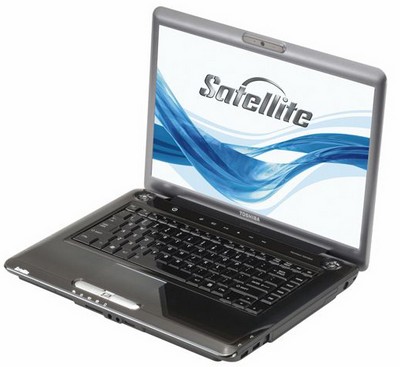
The $900 A300 carries on the Toshiba Satellite tradition of providing all-around value. It's heavier than many of the computers on this list, but with a 320 gigabyte hard drive and 4 gigabytes of memory standard, it is a winner. (toshiba.com)

___

BEFORE YOU BUY


_ If you have a choice of batteries for your laptop, spring for a six-cell battery, which has become an option on many computers, even low-cost ones. While a three-cell battery can provide up to three hours of use, a six-cell can go up to five hours between charges.

_ Budget extra money to install as much memory as the computer can handle (at least 2 gigabytes). That's the quickest way to improve a computer's performance.

_ Think how you or your student will use the computer. Weight and screen size matter. For note-taking, surfing the Web and maximum portability between classes, steer toward the smaller, less expensive laptops. For editing audio or video, running big spreadsheets or other demanding assignments, you'll want a larger screen and bigger hard drive, which makes for a heavier backpack if your student has to lug the computer around campus.

___

LOOKING FOR A DEAL?

_ Go to the computer-maker's Web site and customize the computer you want to buy. Choosing your own setup online can be more confusing and frustrating than buying a preconfigured model in a store, but it lets you save money by choosing lower-priced options (for example, a smaller, less expensive hard drive; meanwhile you can save up to buy a big external hard drive).

_ Go with a hard disk drive, not the slightly more expensive solid-state drive. Solid-state drives are lighter than hard disk drives; don't undergo the wear and tear of hard disk drives; and don't require a noisy fan to keep cool. But the original notion that solid-state drives would last longer than hard disk drives isn't proving to be true, at least with early components. Computer engineers are working on the problem, but for now, I would get a hard disk drive.


----------